Craps variants at a glance
Every version below plays with the same 36 combinations of two dice, or with cards that copy them. What changes is the device, the people, or the come-out rules. The table sorts the craps variants you are most likely to meet by the change that matters and the cost of the pass line under it.
| Variant | What changes | Pass line house edge | Where you find it |
|---|---|---|---|
| Standard casino craps | Nothing, the reference game | 1.41% | Almost every US casino with craps |
| Crapless craps | 2, 3, 11, 12 become points | 5.38% | Palace Station, the STRAT, Borgata’s game guide |
| Bubble craps | Dice in a dome, no dealer | 1.41% | Mount Airy, Blue Lake, Morongo |
| Card craps | Cards decide the roll | 1.41% with a full reshuffle | Pechanga, Barona, Pala, Graton |
| Electronic and stadium | Touchscreen betting | 1.41% | Foxwoods Arena, Golden Nugget, Rivers Philadelphia |
| Street craps | No house, players cover bets | None for a house; the fader holds 1.41% | Private games, illegal in most places |
The pattern is clear. Anything that only changes the machinery leaves your cost where it was, as long as the payouts are standard. Changing the rules is different. Crapless craps is the only popular version that moves the pass line edge, and it moves it the wrong way by almost four times.
Bubble craps: dice under glass
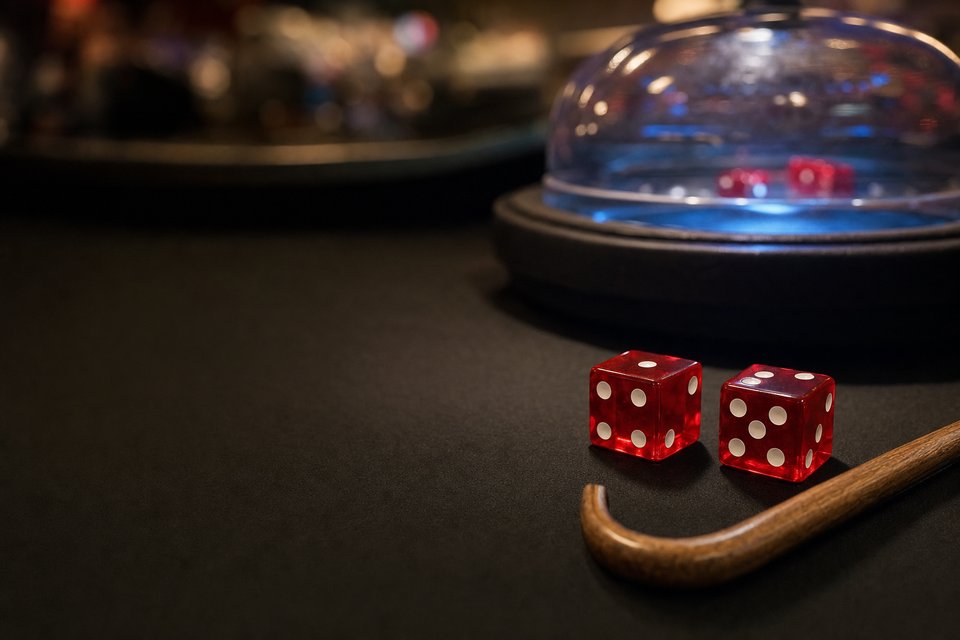
A bubble machine seals two real dice in a clear dome and bounces them with air or a mechanical kicker. Players sit at touchscreens around it, bet against a countdown timer and are paid to their credits. There is no dealer and no stickman, which is why many beginners start here. The bets and payouts match the table.
Mount Airy in Pennsylvania lists one as its latest electronic craps game, and Blue Lake and Morongo in California run them too. Our full guide to bubble craps covers how to play the machine, whether it is rigged, the strategy that holds up and what to play online in the four legal states.
Crapless craps: no losing come-out, a higher price
In crapless craps the 2, 3, 11 and 12 all become points. You cannot lose on the come-out, and only a 7 wins at once. The extra boxes run across the top of the layout. It is a popular game at Palace Station and the STRAT in Las Vegas, and several resorts offer it on electronic tables.
The price is the catch. You give up the 11 as an instant winner and take on points that the 7 usually beats, so the pass line edge rises to 5.38%. Odds still pay true odds on every point. Our page on crapless craps works through each number and lists the rooms that deal it.
Card craps in California and Oklahoma
California law bars banked games in which dice determine the outcome, so tribal casinos deal craps where cards decide the roll. Some draw cards from shufflers, others let real dice pick which of six numbered cards count. With a fresh set of one to six each roll, the odds are identical to dice.
Oklahoma went another way. A 2018 law offered tribes a compact supplement for table games involving dice, run as player-pool games in which the tribe has no stake in the result. Many Oklahoma rooms now deal real dice, sometimes with a player fee. Our guide to card craps explains both states.
Electronic and stadium craps
Electronic craps covers everything you bet on a touchscreen. Video craps runs on a random number generator. Hybrid games such as Roll To Win at Palace Station use live dice with personal betting screens. Stadium craps links a bank of terminals to a live table run by a dealer, so one game can serve many seats.
Minimums on these machines are often lower than in the pit, which is a large part of their appeal. Palace Station lists Roll To Win at $5 with 10x odds, and Golden Nugget in downtown Las Vegas advertises dealer-assisted craps from $5. Our page on electronic craps explains each electronic craps machine and how to play it.
Street craps: when the players are the house
Street craps needs no table and no casino. The shooter bets, another player fades him by betting the other way, and everyone else bets among themselves at prices they agree. With no house, side bets at true odds favor nobody, though under casino come-out rules the player fading the shooter keeps a 1.41% edge.
It is also, plainly, illegal in most of the United States when played for money outside a licensed casino. Our page on street craps covers the rules, the fair prices on points and hardways, and what separates a garage game from a casino table, including who actually holds the edge.
Other rule variants you may meet
Not every change needs its own page. Some are table rules or add-on bets, and some are nearly extinct. Here are the ones worth knowing before you sit down, with the cost of each where our math module can put a number on it. Our side bets guide covers the rest.
New York craps
New York craps is dealt on a double-end-dealer table without come or don’t come bets; players bet the box numbers directly. It was played mostly on the East Coast, and its overall house edge runs higher than the Las Vegas game. None of the casinos in our directory lists it today.
Triple on the 12 in the field
The field normally pays double on the 2 and 12, for a house edge of 5.56%. Some rooms pay triple on one of them, which cuts the edge to 2.78%. Barona in California advertises triple on the 12. It is still a one-roll bet, but at that price the field bet is far less expensive.
Bonus side bets
Bonus Craps, the All Small, All Tall and Make ‘Em All bets, appears at the STRAT and several Choctaw casinos, with Dice-ology at Palace Station. All Small and All Tall carry a 7.76% house edge each, and Make ‘Em All 7.46%, well above the pass line. Pay tables for other side bets vary, so read the sign before betting.
What never changes between craps variants
Under every version with standard payouts, the pass line with odds and the place bets on the 6 and 8 remain the cheapest money on the layout. The minimum place bet is normally the table minimum, and on the 6 and 8 many dealers want multiples of six so the 7 to 6 payout comes out in whole dollars.
Dice control is sometimes sold as a variant of its own, a skill game. The evidence does not support that, and our page on dice control sets out the tests. Whatever table you choose, ask the dealer the odds limit before your first bet: it is the one number no variant shows on the felt.