The craps table layout, explained from the rail
The first thing to notice is that the craps table layout is a mirror image. The left and right ends of the felt carry identical sets of boxes, so players at either end can reach the same bets without stretching. Only the middle strip, the proposition box in front of the stickman, is printed once and shared by everyone.
A craps table explained in one sentence: the edges hold the cheap bets and the middle holds the expensive ones. The pass line runs closest to you, the numbers sit furthest back at each end, and the center box of one-roll wagers is where the house edge runs from about 9% to nearly 17%. Keep that map in mind.
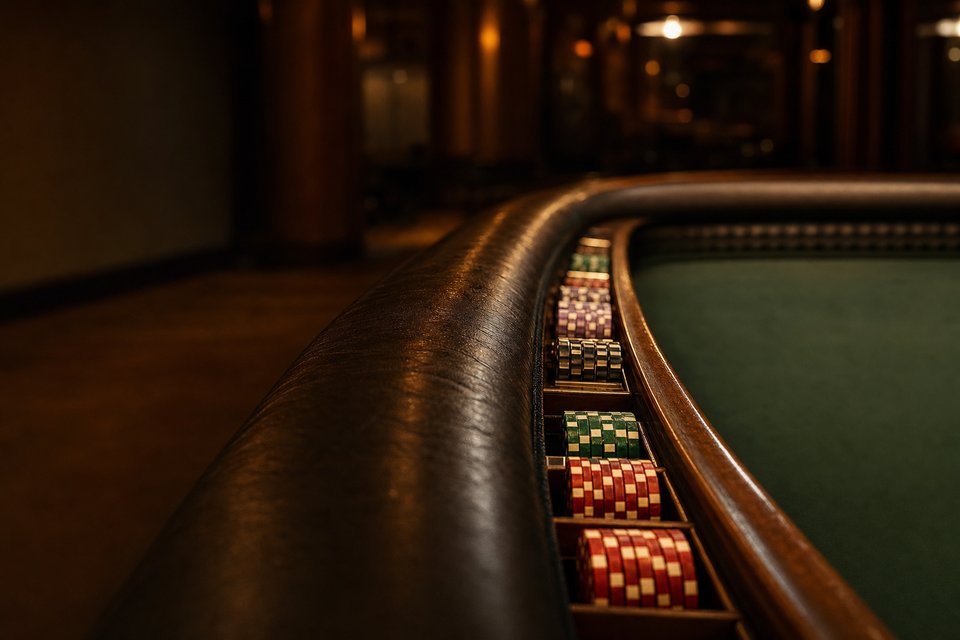
Around the outside runs a padded rail with grooves for your chips, and the inside walls are lined with rubber pyramids. The shooter is expected to throw both dice hard enough to bounce off the far wall, which scrambles the result. Hands and drinks stay clear of the felt while the dice are moving, and dealers will remind you politely.
The line bets along the edge of the layout
The pass line is the long curved strip nearest the rail, and it is where most of the table’s money sits. A pass line bet wins with the shooter at even money and carries a 1.41% house edge. Once a point is set, you can add odds directly behind it, in the plain felt just outside the line.
Just inside the pass line is the narrower Don’t Pass Bar, marked Bar 12. That note tells you a 12 on the come-out pushes instead of winning, which is how the house keeps a 1.36% edge on the don’t pass side. Betting it means you are rooting for the seven, which makes for quiet company at a hot table.
The large rectangle marked Come works like a second pass line you can join mid-hand. A come bet made after the point is set travels to whatever number rolls next, and the base dealer moves your chips into that box. The small Don’t Come box in the corner does the reverse, at the same edge as don’t pass.
The field, Big 6 and Big 8
The Field is the wide box between the come area and the pass line, printed with 2, 3, 4, 9, 10, 11 and 12. It is a one-roll bet: those totals win, anything else loses. On the felt the 2 and 12 are circled because they pay double, and some casinos pay triple on the 12.
Those circles matter more than the rest of the box. With both paying 2 to 1, the Field bet costs 5.56%; with the 12 paying 3 to 1 the edge halves to 2.78%. Check the printing before you bet, because that payout is the one line on this part of the craps table layout that changes from casino to casino.
In each outside corner sits a small box marked Big 6 and Big 8. It pays even money if its number rolls before a 7. That sounds harmless until you notice that a place bet on the same number pays 7 to 6 for the same result. So Big 6 and 8 cost 9.09% against 1.52%. Walk past it.
The place numbers across the back
Across the back of each end sits a row of six boxes: 4, 5, SIX, 8, NINE, 10. The 6 and 9 are spelled out so nobody reads them upside down. These are the point numbers, and they do three jobs: the puck marks the point on one of them, come bets travel into them, and place bets live there.
You never put chips in those boxes yourself. Set them on the felt, say “place the 6 and 8”, and the dealer books them for you. Place bets pay 7 to 6 on the 6 and 8, 7 to 5 on the 5 and 9, and 9 to 5 on the 4 and 10.
Those payouts make the 6 and 8 the best place bets at 1.52%, while the 5 and 9 cost 4% and the 4 and 10 cost 6.67%. The same boxes take buy and lay bets, which pay true odds minus a 5% commission. The table below shows what each zone of the felt costs you.
| Bet | Pays | House edge | Per roll |
|---|---|---|---|
| Pass Line | 1 to 1 | 1.41% | 0.42% |
| Don't Pass | 1 to 1 | 1.36% | 0.40% |
| Come | 1 to 1 | 1.41% | 0.42% |
| Place 6 | 7 to 6 | 1.52% | 0.46% |
| Place 5 | 7 to 5 | 4.00% | 1.11% |
| Place 4 | 9 to 5 | 6.67% | 1.67% |
| Field | 1 to 1; 2 pays 2 to 1; 12 pays 2 to 1 | 5.56% | 5.56% |
| Big 6 | 1 to 1 | 9.09% | 2.78% |
| Hard 8 | 9 to 1 | 9.09% | 2.78% |
| Any Seven | 4 to 1 | 16.67% | 16.67% |
The center of a casino craps table
The proposition box sits in the middle of the casino craps table, directly in front of the stickman. At the top sit the four hardways; below them are the one-roll bets: Any Seven, Any Craps, the 2, 3, 11, 12 and Horn. Down both sides run small circles marked C and E, one for each spot around the rail.
This is the most expensive part of the felt. Hardways cost 9.09% on the 6 and 8 and 11.11% on the 4 and 10, the Horn costs 12.5%, and Any Seven takes 16.67% of every bet, every roll. The proposition bets are fun to watch, which is exactly why they are printed where everyone can see them.
Who works a casino craps table
Any craps table explained without its crew is only half a picture, because four people run a full game. The boxman sits in the middle of the far side, behind the chip bank, and supervises: watching the dice, checking payouts, settling disputes and dropping cash buy-ins into the box. The boxman rarely touches a bet but sees every one.
Opposite the boxman, on the players’ side, stands the stickman with a long hooked stick. The stickman pushes the dice to the shooter, calls every total, and runs the proposition bets in the center. Calls such as “seven out, line away” come from this position, and they tell the whole table in four words what just happened to their money.
The two base dealers stand on either side of the boxman, one for each end of the layout. Each handles every bet on their half: line bets, come bets, place bets and odds. Dealers also rotate through the stick position, so the person paying you now may be calling the dice later in the shift.
The crew works fast, and the table has habits that keep it that way. Cash goes on the felt, never into a dealer’s hand, and you call bets before the dice leave the shooter’s hand. Our guide to craps etiquette covers the rest, and the craps terms page decodes what players shout across the table.
Craps table sizes, rentals and online versions
Casino craps tables usually come in 12-foot and 14-foot lengths, and the layout scales to fit. A busy 14-foot table can hold well over a dozen players shoulder to shoulder along the rail. Downtown Las Vegas rooms such as the Golden Nugget run full-size tables, and the felt you meet there matches the one described on this page.
Tables for home use and party rentals are often shorter, and some are simply a printed felt that lies over a dining table. The boxes stay the same; only the walls and rail change. If you rent one for an event, compare its printed payouts with a real casino felt, starting with the field circles on the 2 and 12.
Online, the craps table layout is drawn on screen instead of on felt. Licensed online craps in New Jersey, Michigan, Pennsylvania and West Virginia comes as computer-dealt games and as live dealer craps such as Evolution Live Craps, which streams real dice with a digital betting grid below the video. The boxes and payouts match a casino pit.
Practice the layout on a free table
The quickest way to learn the felt is to put chips on it. The free table below uses the standard casino layout: click a box to bet, roll, and watch where your chips go. Try a come bet after a point is set and see it travel into its number, then check what the field pays on a 12.
One detail to watch on a real felt: when you place the 6 and 8, the dealer sets your chips on the edge of each box that lines up with your spot at the rail. If a 6 rolls and you have not been paid, point to that spot at once, before the stickman sends the dice out again.