- Pays
- 9 to 1
- House edge
- 9.09%
- Decided by
- Pair, easy or 7
- Can be made
- Any roll, off on the come-out by default
What are the hardways in craps?
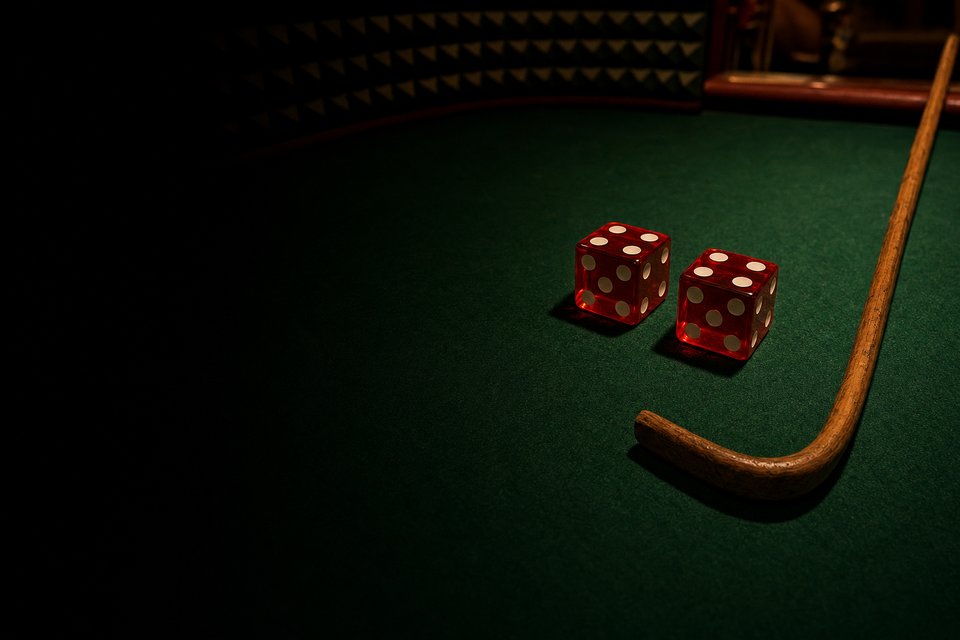
There are four hardways, one for each even point number: 4, 6, 8 and 10. A number is rolled hard when both dice match, so a hard 4 is 2-2, a hard 6 is 3-3, a hard 8 is 4-4 and a hard 10 is 5-5. Any other way to make the total is the easy way.
The four bets sit in the middle, and the stickman books them. You toss chips toward the center and call it, say “hard eight for five”, and the crew places it. The odd point numbers, 5 and 9, cannot be rolled as a pair and have no hardway. Our craps table layout guide shows where the boxes sit.
How a hardway wins and loses
A hardway stays up until decided. The pair wins it. It loses on a 7, and it also loses when the same total comes up the easy way. Your hard 8 dies to a 5-3 or a 6-2 just as surely as to a seven. Every other roll leaves it standing.
The hard 8 and hard 6 in craps
The hard 6 and hard 8 both pay 9 to 1. Look at the hard 8. Only one combination wins, 4-4. It loses to the four easy eights (2-6, 6-2, 3-5 and 5-3) and to the six ways to roll a 7. That is one winning combination against ten losing ones, so the true odds are 10 to 1.
The casino pays 9 to 1 instead of 10 to 1, keeping that one unit. A $5 hard 8 that hits pays $45. The hard eight wins about 9.09% of the times it is decided, and the house edge is 9.091%. The hard 6 works the same way with 3-3 against 1-5, 5-1, 2-4, 4-2 and the sevens.
Hard 4 and hard 10: the 7 to 1 hardways
The hard 4 and hard 10 pay less. A hard 10 wins only on 5-5. It loses to the two easy tens, 4-6 and 6-4, and to the six sevens. That is one winner against eight losers, true odds of 8 to 1, and the casino pays 7 to 1. The hard 4 mirrors it.
Falling a full unit short of 8 to 1, the hard 4 and hard 10 carry a house edge of 11.111%, worse than the 6 and 8. They win 11.1% of the time they are decided, more often than the hard 6 or 8, but the lower payout cancels that. A $5 hard 10 pays $35.
| Bet | Pays | House edge | Per roll |
|---|---|---|---|
| Hard 4 | 7 to 1 | 11.11% | 2.78% |
| Hard 6 | 9 to 1 | 9.09% | 2.78% |
| Hard 8 | 9 to 1 | 9.09% | 2.78% |
| Hard 10 | 7 to 1 | 11.11% | 2.78% |
| Place 8 | 7 to 6 | 1.52% | 0.46% |
| Pass Line | 1 to 1 | 1.41% | 0.42% |
Hardways side by side
| Bet | Wins on | Loses on | Pays | True odds | House edge |
|---|---|---|---|---|---|
| Hard 4 | 2-2 | 1-3, 3-1, any 7 | 7 to 1 | 8 to 1 | 11.111% |
| Hard 6 | 3-3 | 1-5, 5-1, 2-4, 4-2, any 7 | 9 to 1 | 10 to 1 | 9.091% |
| Hard 8 | 4-4 | 2-6, 6-2, 3-5, 5-3, any 7 | 9 to 1 | 10 to 1 | 9.091% |
| Hard 10 | 5-5 | 4-6, 6-4, any 7 | 7 to 1 | 8 to 1 | 11.111% |
Off on the come-out roll
In most casinos the hardways are off on the come-out roll unless you tell the dealer otherwise. A come-out 7 wins the pass line and would otherwise wipe out every hardway at once. So by default the bets stay on the felt but do not work, and a come-out 4-4 does not pay either.
If you want them working, say “my hardways are on” before the roll, and a dealer will confirm it. The next come-out 7 then takes them all. Unlike the pass line, a hardway is not a contract bet. You can take it down or call it off between any two rolls, which helps when a new come-out is coming.
What craps hardways cost per roll
A hardway can sit through dozens of rolls, so its edge per decision hides how busy it is. Measured per roll, every hardway costs about 2.78% of the bet: the expected loss works out to one unit per 36 rolls. A $5 hard 8 left up costs you roughly 14 cents a roll on average.
That is six times the rate of a place bet on the 8, which costs 0.46% per roll. Leave $5 on each of the four hardways and you are paying about 56 cents a roll to keep them up. Enter your own stake below and compare the hard 8 with the other bets on the layout.
Hard 8 versus place 8 and Big 8
A fan of the 8 has three ways to bet it. The Big 8 pays even money on any 8 before a 7 and costs 9.09%. A place 8 pays 7 to 6 on any 8 and costs 1.52%. The hard 8 pays 9 to 1 on the pair only and also costs 9.09%.
The place bet is the only sensible one of the three. It wins on all five ways to roll an 8, and the price is a sixth of the others. If you want a hardway for the excitement, make it a small add-on next to a place bet, not the main event.
Hopping the hardways and other variations
A hardway is a multi-roll bet. You can also bet a pair for the next roll only, called a hop bet. A hop on 4-4 pays 30 to 1 at most tables and carries a 13.89% edge, and it loses on any other roll at all. It belongs with the proposition bets, not with the hardways.
Watch the wording on the layout. Some tables print the hardway payouts as “for 1” instead of “to 1”. Eight for 1 returns your stake inside the eight, so it equals 7 to 1; nine for 1 is only 8 to 1. If the hard 6 box says “for”, ask the dealer what it actually pays.
Hardways in online craps
Licensed online craps in New Jersey, Michigan, Pennsylvania and West Virginia carries the same four hardways in the center block. You click the box instead of calling it, and the software settles it the moment a pair, an easy number or a seven lands. Check the rules screen for how they are treated on the come-out.
Live-dealer tables, such as Evolution Live Craps, deal real dice on camera and handle hardways like a casino pit. The math does not change on a screen, and neither does the pace problem. A fast online craps game can run through far more rolls in an hour than a crowded table, which multiplies the per-roll cost above.
Are hardways worth betting?
As a regular part of your action, no. The best hardway costs 9.09% per decision, more than six times the pass line, and its per-roll price stays high because the bet lingers. Anyone following a real craps strategy keeps the money on the line, the odds and the 6 and 8 place bets instead.
As an occasional dollar for fun, the hard 6 or hard 8 is the least bad of the four, paying 9 to 1 against a true 10 to 1. Skip the hard 4 and hard 10. And when you toss a chip to the stickman, say the number and the amount clearly, or it may end up somewhere else.