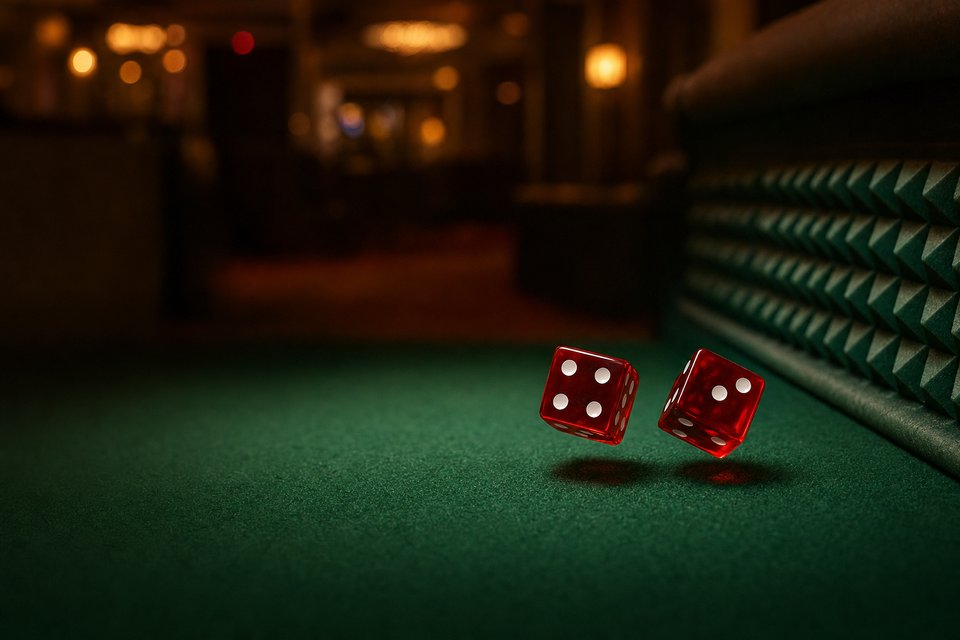
What the free craps game on this page includes
The table above is a 3D craps table with twelve bets: the Pass Line and Don’t Pass, odds behind both, Come, the Field and place bets on the 4, 5, 6, 8, 9 and 10. It leaves out the proposition box, the hardways and the Big 6 and 8. Our guides to proposition bets and hardways cover those instead.
You start with a practice bankroll of $500 and four chip values: $1, $5, $25 and $100. Click a chip to select it, then click a bet button or the printed area on the felt to place it. The bankroll updates after every roll, so you always see what you have left and what is still working on the table.
Each bet carries a house edge readout, and every figure agrees with the math that runs the rest of this site. A Pass Line chip reads 1.41%, Place 6 reads 1.52% and Place 4 reads 6.67%. Seeing that price beside the bet, before the dice move, changes the way most people bet within a few minutes of starting.
The dice come from your browser’s cryptographic random number generator, the kind used for security keys, not a simple shuffle formula, and each die is drawn on its own. Under the table sit three buttons: Roll, Take bets down, which pulls back every bet the rules let you remove, and Reset, which returns you to a fresh $500.
| Bet on the table | What it pays | House edge |
|---|---|---|
| Pass Line / Come | 1 to 1 | 1.41% |
| Don’t Pass | 1 to 1 | 1.36% |
| Odds behind Pass or Don’t Pass | True odds | 0.00% |
| Place 6 or 8 | 7 to 6 | 1.52% |
| Place 5 or 9 | 7 to 5 | 4.00% |
| Place 4 or 10 | 9 to 5 | 6.67% |
| Field (2 pays 2 to 1, 12 pays 3 to 1) | 1 to 1 | 2.78% |
How to play craps online free on this table
The quickest way to play craps online free is the table above. A hand starts with the come-out roll: put a chip on the Pass Line, press Roll. A 7 or 11 wins at once, a 2, 3 or 12 loses, and any other total becomes the point. Our guide on how to play craps covers the rest.
Once a point is set, the puck turns ON and the point is marked on the table. The Pass Line now wins if the point repeats before a 7. This is the moment to add odds behind your line bet. The odds bet pays true odds and carries no house edge at all, which is rare in a casino.
Placing bets and taking them down
Place bets can go up at any time, though they are off on the come-out roll, and they stay until they win or come down. Take bets down lifts every bet a real dealer would let you pick up. A Pass Line bet stays put after the point, because it is a contract bet.
The Field is a one-roll bet: it settles after a single roll, win or lose, and then it is gone. If you want the same bet on the next roll, you place it again. Small detail. It teaches the rhythm of a live table faster than any written description can. Come bets here are flat, with no odds behind them.
When the rack runs out
Press Reset and you have $500 again. There is no timer, no limit on resets and no pop-up asking for an email address. Treat each reset as information, though. If a $500 rack keeps lasting twenty minutes, the bets you are choosing cost too much, and the house edge readout will usually point straight at the culprits.
A first session plan for the free craps game
Give your first session some structure and it teaches far more. Start with forty rolls of Pass Line only, $5 a hand. Watch how often the come-out wins outright, about 22% of the time, and how often it sets a point, two times in three. You will see the two-stage rhythm of the game before any other bet distracts you.
For the next forty rolls, add odds. Put $10 behind a $5 Pass Line bet on every point. On a 6 or 8 the odds pay 6 to 5, on a 5 or 9 they pay 3 to 2, and on a 4 or 10 they pay 2 to 1. Check each payout against those prices.
Then add one Come bet after each point is set. It behaves like a second Pass Line bet that starts mid-hand, and the dealer moves it to its own number. Most beginners find this the confusing part of the game, and twenty rolls here clear it up before a real dealer is waiting.
Finish with a single Field bet and a single Place 4, just to feel what the pricier bets cost. Note your bankroll before and after. Over a short run anything can happen, but the readout gives the long-run price: 2.78% on this table’s Field and 6.67% on a Place 4 or 10.
| Block | Rolls | What you bet | What to watch |
|---|---|---|---|
| 1 | 40 | $5 Pass Line | Naturals, craps and points on the come-out |
| 2 | 40 | $5 Pass Line + $10 odds | Odds payouts on each point |
| 3 | 20 | Add one $5 Come bet | Where the dealer moves the Come bet |
| 4 | 10 | One Field, one Place 4 | How fast the pricier bets drain the bankroll |
What to practice before you play craps for money
Timing matters more than most new players expect. Bets have to be down before the stickman sends the dice out, and at a busy table it comes quickly. Practice placing your Pass Line chip, then your odds, then any place bets, in the same order every hand. On the free table you can repeat that sequence until it feels automatic.
Learn which bets you can remove and which you cannot. Pass Line and Come bets are locked once they have a point, while odds and place bets can come down. The Take bets down button follows those rules exactly, so every time it leaves a chip on the felt, you learn a rule you would otherwise hear from a dealer.
Practice the payouts in your head. A $6 place bet on the 6 pays $7, a $5 place bet on the 5 pays $7, and $10 in odds on a 6 pays $12. If you can say the number first, you will spot a short payout at a real casino. The payout trainer drills exactly this skill.
Practice a stopping rule as well. Decide before the first roll that you will walk away at, say, $300 or $700, and hold to it. Nothing on the free table forces you to, and that is the point. A practice session is the cheapest place to learn whether you keep the promises you make to yourself at a table.
Testing a system
Many players arrive with a system: the Iron Cross, the 3-Point Molly or a Martingale progression. The free craps game is fine for learning how a system is laid out, but a few hundred rolls tell you almost nothing about how it performs. For that, the Strategy Lab runs thousands of shooters and shows the whole spread of results.
Free craps vs real money online craps
The dice work the same either way. What changes with money is the law. Seven US states license online casinos, and New Jersey, Michigan, Pennsylvania and West Virginia are the big markets. You have to be 21 or older and physically inside the state while you play, and the casino checks your location before it lets you place a bet.
Each of those states licenses its operators through its own regulator: the New Jersey Division of Gaming Enforcement, the Michigan Gaming Control Board, the Pennsylvania Gaming Control Board and the West Virginia Lottery Commission. Our guide to online craps covers what is offered in each state, including live dealer craps with real dice rolled on camera.
Outside those seven states, a site offering you real-money craps is not licensed where you live, whatever its homepage claims. Free play is legal everywhere because nothing of value is at stake. That makes the free craps game on this page the practical choice for most of the country, and a sensible warm-up for players in the licensed states.
The math does not soften when you switch. A 1.41% edge on the Pass Line is 1.41% on a $5 practice chip and on a real $25 bet. The real difference is emotional: losing money feels heavier, and people bet bigger to win it back. Set a budget before any deposit, and read our responsible gambling page first.
| Feature | Free table on this page | Licensed online craps |
|---|---|---|
| Where | Anywhere in the US | NJ, MI, PA and WV only |
| Age | Adult audience, no check | 21+, verified |
| Sign-up | None | Account, ID and location check |
| Chips | $500 practice rack, resets on demand | Your own money |
| Winnings | None, chips have no value | Real, withdrawable |
| House edge | Shown on every bet | Same math, rarely shown |
Free craps apps vs playing craps online in a browser
Search an app store for craps and you will find dozens of free games. Many are social casino apps: free to download, then built around selling extra virtual chips when yours run out. Those chips can never be cashed out, and the prompts to top up appear exactly when you are losing. That design is worth noticing.
A browser table skips all of that. Nothing to install, no account, no permissions. You can play craps online free on a phone, a tablet or a laptop, and the table scales to your screen. On a phone the whole table fits in view, and you can drag to look around it.
Real-money craps apps are a different product. In the four legal states, licensed casinos run their own apps with real-money tables, and those need an account, identity checks and location services. Our round-up of craps apps explains how they work. For practice, the browser table is quicker to open and leaves nothing behind on your device.
One honest limit: a free craps game cannot give you the feel of a crowded rail on a hot roll, with a dozen people shouting. Live-dealer games such as Evolution’s live craps come closer, with real dice in a studio, but they are real-money only. The free table teaches the game and its prices, and does that well.
Is a free craps game fair and safe?
Fair means every total comes up as often as the math says. Our dice use your browser’s cryptographic generator and each die is drawn separately, so a 7 arrives six ways in 36 and a 12 one way in 36, exactly as on real dice. Doubt it? Record a few hundred rolls in the roll log and test them.
Safe means nothing leaves your screen. This table has no sign-up, stores nothing and asks for no personal details. Hold any free craps site to that. A free game that wants your phone number, a card number or a small deposit to top up your chips is not really free, so close the tab.
Watch for rogue sites as well. Some free craps pages exist to pass you on to unlicensed real-money casinos, often offshore, that accept players from any state. No US regulator oversees those sites, and if a withdrawal goes wrong you have nowhere to complain. A casino licensed in New Jersey or Pennsylvania displays its state license on the site itself.
A quick test for any free craps site: does it show the house edge of each bet, or hide it? An honest practice table has no reason to hide the price. If the Field bet is dressed up as the smart play and nobody mentions its 5.56% edge, you have learned something about who built the page and why.
From the free table to a real one
Reading about craps gets you the rules. The free table gets you the order of events, the timing and the payouts, which is most of what makes a real table feel intimidating. A casino then adds noise, other players and a minimum bet. Taking those steps in that order, one at a time, is how most confident players actually learned.
When you do walk up to a real table, buy in between rolls rather than while the dice are out, and put your cash on the felt instead of handing it to the dealer. The craps etiquette page covers the rest. Your first bet should be the one you practiced most here: a Pass Line chip, then odds.
Bring one habit with you: read the layout before you bet. Many casinos print the Field payouts on the felt, and the 12 pays either double or triple. This table pays triple, which cuts the Field edge from 5.56% to 2.78%, half the price. Which one is printed on the table in front of you?