Hazard in medieval England
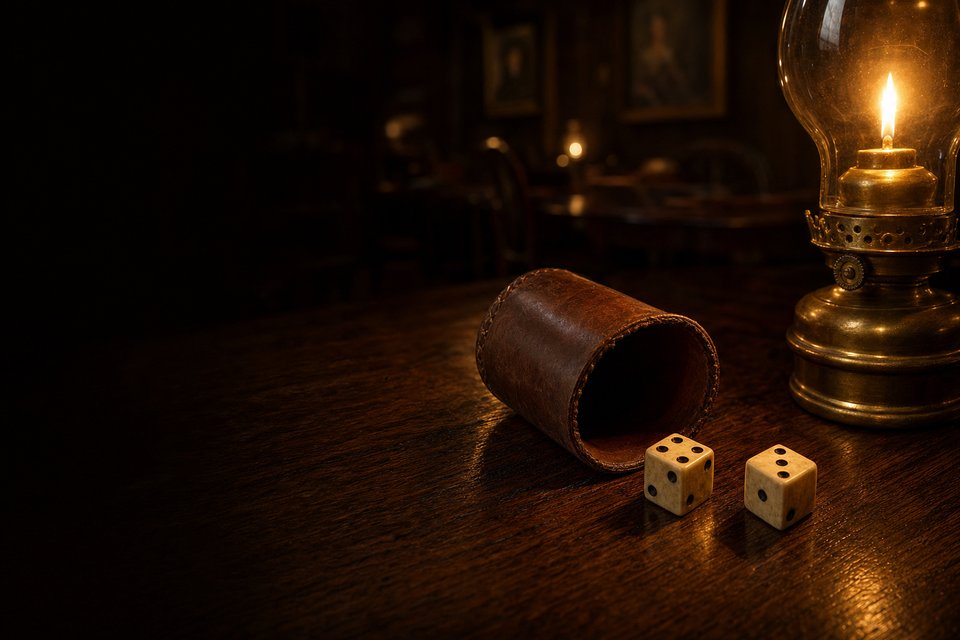
The history of craps begins with hazard, a dice game played in England for centuries. Geoffrey Chaucer mentions it in the Canterbury Tales in the fourteenth century, which makes it one of the earliest dice games on record in English. The name probably came through Old French from the Spanish azar, meaning an unlucky throw.
Hazard was more complicated than craps. The caster called a number, the main, somewhere between 5 and 9, then threw. Some throws won at once, some lost at once, and the rest became the chance, which the caster then tried to repeat before rolling the main. Bystanders bet on the outcome at odds that changed with every main.
By the seventeenth century hazard was a fixture of English gambling. Charles Cotton, in The Compleat Gamester of 1674, called it “the most bewitching Game that is plaid on the Dice”. In the London clubs of later generations, Crockford’s among them, hazard was played for serious money, and Hoyle’s Games Improved printed its full rules and odds in 1790.
From crabs to craps: the French connection
In hazard the throws of 2 and 3 were called crabs, and they lost for the caster. When the game crossed the Channel to France, before the end of the eighteenth century, it went as krabs. The French word craps followed in the early nineteenth century, and that is the form that eventually reached America.
That explains the question of why the game is called craps, which our craps terms glossary covers alongside the rest of the table slang. The word for the losing throw simply became the name of the whole game. Today it still means both: a come-out 2, 3 or 12 is craps, and so is everything around it.
Bernard de Marigny and New Orleans
The American chapter in the history of craps starts in New Orleans. According to some accounts, Bernard Xavier Philippe de Marigny de Mandeville, a wealthy young Creole, brought hazard back from London around 1805. The story is widely repeated, but it rests on tradition more than documents, so treat the credit as likely rather than proven.
Whoever carried it, the game changed in Louisiana. It was simplified, and it went by the name pass, from the French pas, meaning a pace or step. The name survives in the pass line. The early nineteenth-century version was popular with working people rather than the aristocrats who played hazard in London, and it traveled with them.
Up the Mississippi on the riverboats
Field hands taught friends and deckhands, and they carried the game up the Mississippi River and its tributaries. Riverboats and river towns spread it further. Street versions needed nothing but two dice and a wall, which is why street craps still exists, played against other players with no bank at all.
John H. Winn and the don’t pass bar
The game that casinos run today owes most to John H. Winn, a dicemaker in Philadelphia. Around 1907 he introduced a layout with a space to bet don’t pass, so players could bet with or against the shooter, with the house covering both. That made a banked game far easier to run.
Winn’s first don’t pass bets were taken with a 5 percent commission. That was replaced by barring the 3, and later by barring the 12, or at some tables the 2. The bar turns one craps roll into a push, and it is why a don’t pass bet still carries a house edge of 1.36% instead of favoring the player.
The change looks small. It is the reason craps could move indoors. With a fixed layout and a house that earned a small edge on every bet, casinos could offer the game safely, and the modern arrangement of line bets, place bets and propositions grew out of it during the following decades.
Military craps and the Second World War
Craps exploded in popularity during the Second World War, which brought most young American men of every social class into the military. The game needed only dice, took a minute to learn and could be played on a barracks floor or a ship’s deck. Millions of servicemen learned it, and many of them kept playing after coming home.
That wave of players arrived just as legal casino gambling was growing in Nevada. It gave the history of craps its biggest audience yet, and it helped turn a street and barracks game into the loudest table on the casino floor, the one where cheers carry across the room when a shooter keeps making points.
Las Vegas, Atlantic City and online tables
In the Las Vegas casinos of the postwar decades, craps became the signature table game. Downtown rooms and the new Strip resorts ran busy tables, and competition between them later pushed odds limits higher. Our Las Vegas casinos guide covers where the game is played now, from downtown Fremont Street to the Strip.
Atlantic City opened its first legal casino in 1978 and brought the game to the East Coast. Later came electronic versions such as bubble craps, with dice rolled under a clear dome. Since New Jersey opened regulated online gaming in 2013, online craps has spread to Michigan, Pennsylvania and West Virginia too.
The longest craps roll in history
The longest craps roll in history happened at the Borgata in Atlantic City in 2009. Patricia DeMauro, a grandmother from New Jersey, rolled the dice 154 times without sevening out, a hand that lasted four hours and 18 minutes. It broke the records for the longest craps hand and the most successive rolls in one turn.
The odds of such a hand are tiny, since a seven arrives on one roll in six. Most shooters seven out within a few points, and an hour-long hand is rare anywhere. If you ever find yourself on the rail next to a long one, keep your hands out of the table and do not say the word.