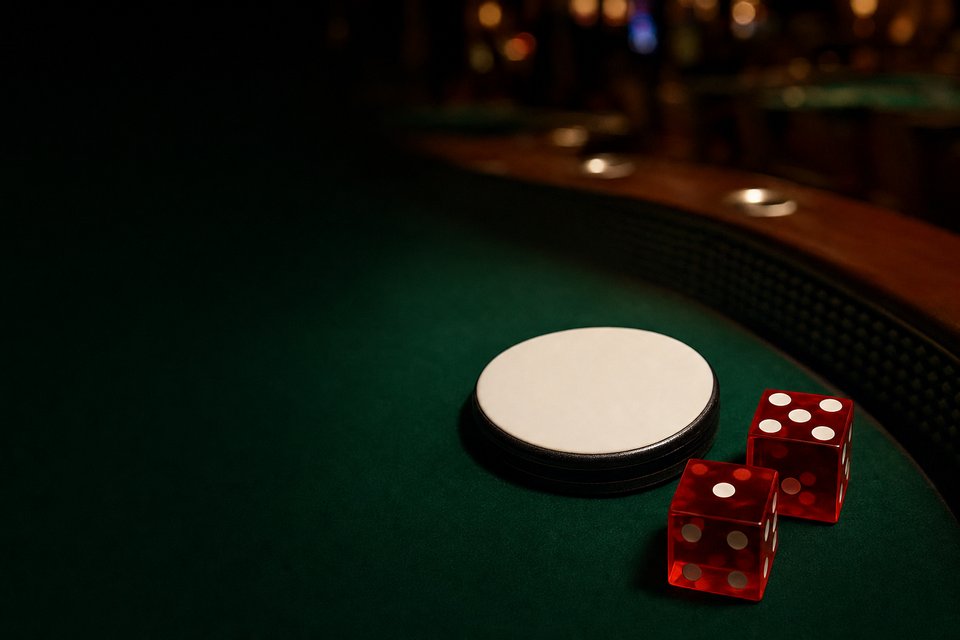
How a hand starts: the come-out roll
A new shooter must have a bet on the pass line or don’t pass before throwing. The stickman offers a small group of dice, the shooter picks two, and throws them one-handed so they hit the far wall. The puck sits OFF, usually in the Don’t Come box, which tells everyone the next throw is a come-out roll.
Only three kinds of result exist on that roll. A natural, 7 or 11, turns up 8 ways out of 36, a 22.22% chance. Craps, 2, 3 or 12, turns up 4 ways, 11.11%. The remaining 24 combinations, exactly two thirds, set a point. The explorer below shows each combination behind those numbers.
Naturals and craps on the come-out roll
A natural pays every pass line bet at even money and takes every don’t pass bet. Nothing else changes. The puck stays OFF, the dealers settle the line, and the same shooter picks up the dice for another come-out roll. Seven and eleven are the only totals that end a pass line decision in a single throw.
Craps works the other way round. A 2, 3 or 12 loses the pass line, while don’t pass wins on the 2 and 3 and pushes on the 12, the rule behind the house edge there. The shooter still keeps the dice. A come-out craps is a loss for the table, never the end of a turn.
That point confuses a lot of first-time players, because the word craps sounds final. It is not. Only a seven after a point ends the shooter’s hand, so a player can roll craps three times in a row and keep shooting. For the calls you will hear around these rolls, see our list of craps terms.
Setting the point and turning the puck
Any 4, 5, 6, 8, 9 or 10 on the come-out becomes the point. The dealer flips the puck to its white ON side and sets it on that number in the back row of the craps table layout. Players arriving mid-hand can read the whole state of play from that one disc.
Now only two totals decide the line bets: the point wins pass, a 7 wins don’t pass. Every other roll, 2, 3, 11 and 12 included, leaves the line alone. The chance of making the point is 45.45% on a 6 or 8, 40% on a 5 or 9, and one in three on a 4 or 10.
That is the moment to back your bet. An odds bet placed behind the pass line pays true odds, 6 to 5 on the 6 or 8, 3 to 2 on the 5 or 9 and 2 to 1 on the 4 or 10. It carries no house edge, and it only becomes available once the point is on.
Come bets and place bets while the point is on
Once the puck is ON, the Come box opens. A come bet treats the next roll as its own private come-out: a 7 or 11 wins it, a 2, 3 or 12 loses it, and any point number sends your chips into that number’s box. From there it wins if the number repeats before a 7.
Place bets skip that first step. You tell the dealer which numbers you want, and the bet wins every time its number rolls before a 7, paying 7 to 6 on the 6 and 8. Unlike line and come bets, place bets can be taken down or reduced whenever you like, because they are not contract bets.
A single roll during the point can therefore pay several players in different ways. Say the point is 6 and an 8 rolls. The pass line stays put, anyone placed on the 8 is paid 7 to 6, a fresh come bet travels to the 8, and a come bet already on the 8 wins and returns to its owner.
Making the point, and the seven-out
When the shooter rolls the point, the pass line wins even money, the odds behind it win true odds, and don’t pass loses. The puck goes back to OFF and the same shooter starts another come-out roll. Come bets on other numbers stay up, though their odds are normally off during that come-out unless you ask otherwise.
A 7 before the point is the seven-out. Pass line bets lose, don’t pass wins, and every come bet and place bet on the numbers loses with its odds. The stickman calls “seven out, line away”, the dealers clear the felt, and the dice move clockwise to the next player, who may shoot or decline.
What each result does to your bets
The table below puts the whole cycle in one place. Read across a row to see how one roll settles each kind of bet. It assumes default casino rules: come bet odds and place bets are off on the come-out, which is how most tables run unless a player calls them working.
| Roll | Pass line | Don’t pass | Come bets on numbers | Place bets |
|---|---|---|---|---|
| Come-out 7 | Wins | Loses | Flat loses, odds returned | Off, stay up |
| Come-out 11 | Wins | Loses | No action | Off, no action |
| Come-out 2 or 3 | Loses | Wins | No action | Off, no action |
| Come-out 12 | Loses | Pushes | No action | Off, no action |
| Point made | Wins | Loses | Wins if on that number, others stay | Wins if on that number, others stay |
| Other number during point | No action | No action | Wins if on that number | Wins if on that number |
| Seven-out | Loses | Wins | All lose | All lose |
The row most players misread is the come-out 7. It pays the pass line and in the same instant takes the flat part of every come bet on the numbers. That is why regulars with several come bets working are quieter on a come-out than anyone else at the table, and why dealers remind them their odds are off.
Side bets on the length of a hand
Some tables add a Fire Bet, one of several side bets tied to how long a shooter lasts. It pays when the shooter makes four, five or six different points before a seven-out, at 24, 249 and 999 to 1. All six happens about 0.016% of the time, and the bet costs 20.76%, so treat it as a lottery ticket.
Run a hand on the free table
The table below plays by the rules on this page. Put a chip on the pass line, roll a come-out, and watch the puck turn when a point is set. Then add a come bet and place the 6 and 8, and see what the next seven takes. The odds behind each result are on our odds page.
One habit worth copying from regulars: glance at the puck before every bet. If it reads OFF, your place bets and come bet odds will sit out the next roll. Want the 6 and 8 working through the come-out? Say so before the stickman sends the dice, and the dealer marks them with an ON button.