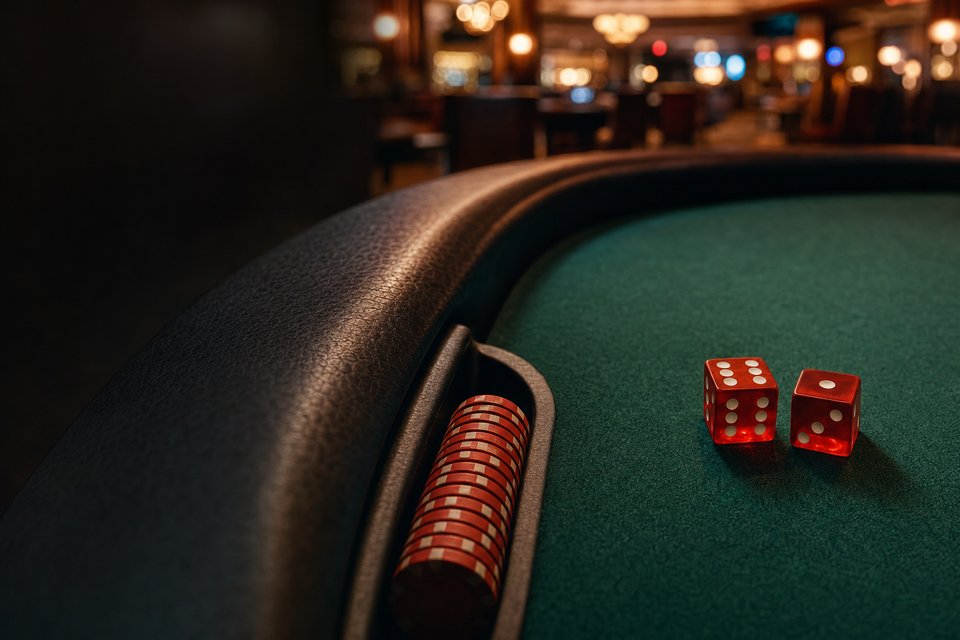
The casino craps table and the crew who run it
A craps table is a long tub with padded rails, a mirrored layout on each half and a common center strip. Both ends carry the same pass line, come box, field and place numbers, so you bet on whichever half you stand at. Our craps table layout guide labels every box, if you want a map first.
The table is run by a crew of four. Two base dealers stand on the near side, one for each end, and they take your bets and pay them. The boxman sits between them guarding the chip bank and watching every payout. Opposite him the stickman handles the dice with a long curved stick and calls each roll.
The stickman also looks after the proposition bets in the middle of the table, the one-roll wagers such as Any Seven, Any Craps and the hardways. His patter is part of the show, and it is designed to sell those bets. Hearing “yo eleven, bet the yo” is normal. Buying it every roll is how a bankroll disappears fast.
The puck, the rail and the placard
Look for three things before you walk up. The puck is a black and white disc: black side up and marked OFF means a come-out roll is next. The rail holds your chips in grooves in front of you. And the placard on the inside edge shows the table minimum and maximum, which is the first number that matters.
How to play craps at a casino: buying in and your first bet
Knowing how to play craps at a casino starts before the dice move. Find a table whose minimum lets you make about thirty bets with the money you brought. At a $10 table that means $300. Squeeze into a space on the rail, wait until the dice are in the middle, and put your cash flat on the felt.
Say “change, please” and the base dealer will slide the money to the boxman, count it and push chips back to you. Never hand cash directly to a dealer, and never drop it while the shooter is throwing. The crew will not take it mid-roll, and a loose bill on the layout during a throw only slows things down.
Now bet. Put a chip on the pass line in front of you before the come-out, while the puck is off. That bet is yours to place yourself. Bets in the middle of the table and on the place numbers are different: you toss the chips to the dealer and say what you want, and he sets them.
Choosing where to stand
Beginners do well standing next to a base dealer, near the corner of the table. You can hear every call, your line bet is right in front of you, and the dealer can help if you ask a question. The far end near the stickman is louder and further from the chips that pay your pass line.
Craps rules for beginners: come-out, point and seven-out
The core craps rules fit in three sentences, and everything else is detail. A new hand starts with the come-out roll. If it shows 7 or 11 the pass line wins; if it shows 2, 3 or 12 the pass line loses; any other total becomes the point. Those are the craps rules for the first roll.
A come-out settles quickly more often than people expect. Eight of the 36 dice combinations are naturals and win straight away, and four are craps and lose. That leaves 24 combinations, or two come-outs in three, that set a point. Our page on the come-out roll and the point breaks each outcome down further for beginners.
What the point does
When a point is set the dealer flips the puck to ON and places it on that number. Now only two totals matter to the pass line: the point wins, a 7 loses. A 6 or 8 point is made 45.45% of the time, a 5 or 9 40%, a 4 or 10 one time in three.
The seven-out ends the hand
If a 7 arrives before the point, the shooter has sevened out. Pass line, come and place bets all lose, and the dice pass clockwise to the next player. Making the point is different: the shooter keeps the dice, the puck goes back to OFF, and a fresh come-out roll begins with the same person throwing.
That structure explains why a shooter can hold the dice for an hour. Every time a point is made, the hand simply restarts. Only a seven-out takes the dice away. The 7 is the most common total on two dice, rolled six ways out of 36, so it always wins in the end. The question is only when.
The main craps bets, ranked from best to worst
There are dozens of bets on the layout, but a beginner needs only a handful. Here they are in order of value, cheapest first. The house edge is the share of each dollar decided that the casino keeps over time, and the gap between the top and bottom of this list is enormous, more than ten times over.
| Bet | Pays | House edge | Per roll |
|---|---|---|---|
| Pass Line | 1 to 1 | 1.41% | 0.42% |
| Don't Pass | 1 to 1 | 1.36% | 0.40% |
| Come | 1 to 1 | 1.41% | 0.42% |
| Place 6 | 7 to 6 | 1.52% | 0.46% |
| Field | 1 to 1; 2 pays 2 to 1; 12 pays 2 to 1 | 5.56% | 5.56% |
| Big 6 | 1 to 1 | 9.09% | 2.78% |
| Hard 8 | 9 to 1 | 9.09% | 2.78% |
| Any Seven | 4 to 1 | 16.67% | 16.67% |
Pass line and odds
The pass line bet pays even money and costs 1.41%. Once a point is set you can back it with an odds bet, which pays true odds and carries no house edge at all. At a common 3-4-5x table the combined cost falls to 0.37%. Nothing else in the building is cheaper than that.
Don’t pass and come
Don’t pass is the same bet from the other side, at 1.36%, with the 12 as a push on the come-out. The come bet works exactly like the pass line but can be made mid-hand, with its own come-out on the next roll. Both are sound choices once the pass line feels comfortable and you want more action.
Place 6 and 8
A place bet on the 6 or 8 pays 7 to 6 and costs 1.52%, close to the line bets. You can make it any time a point is on. Our guide to place bets explains why the 5, 9, 4 and 10 are much dearer, at 4% and 6.67%, even though their payouts look more generous on paper.
The bets to leave alone
The Field bet is one roll at 5.56%. Big 6 and Big 8 cost 9.09% for the same numbers the place 6 and 8 pay better on. Hardways cost 9% to 11%, and the one-roll proposition bets in the center run from 11% to 16.67%. They are fun in small doses and expensive as a habit.
Craps etiquette: the basics every casino table expects
Craps is a social game with a few firm habits, and following them marks you as someone who knows how to play craps rather than someone learning at everybody’s expense. The rules are simple. Most exist either to protect the dice from tampering or to keep a fast game moving without arguments over whose chips are whose.
Keep your hands out of the table when the stickman pushes the dice to the shooter. A die that hits a hand can cost the shooter a roll, and some players take that personally. Drop bets early, before the stickman calls “dice are out”, and let the dealer finish paying one roll before you ask for the next bet.
When you shoot, use one hand and throw so both dice bounce off the far wall. That rule is enforced everywhere, from the Golden Nugget in downtown Las Vegas to Borgata in Atlantic City. A soft toss that stops short will usually be allowed once, with a polite reminder, and then the boxman will ask you to throw harder.
Some customs are unwritten. Don’t say “seven” out loud during a hand, because many players think it jinxes the shooter. Tip the crew by placing a small bet for the dealers rather than handing over chips. And color up before leaving: the dealer swaps your chips for fewer, larger ones. Our craps etiquette guide covers the rest.
Playing craps online versus a live casino table
Online craps follows the same craps rules as the pit, point and seven-out included. Real-money play is legal in New Jersey, Michigan, Pennsylvania and West Virginia for adults 21 and over who are inside the state, on sites licensed by regulators such as the New Jersey Division of Gaming Enforcement. Our online craps guide covers each state.
There are two formats. Computer-dealt tables use a random number generator and let you play at your own speed, with lower minimums than any casino floor. Live dealer craps, such as Evolution’s Live Craps, streams real dice from a studio and settles bets on screen. Both are useful for learning how to play craps at a casino without the crowd.
What you lose online is the table itself: the noise, the long hands and the shared cheer on a made point. What you gain is time to think. There is no rush to make a bet, nobody watches your chips, and you can check every payout at your own pace. For a nervous first-timer that quiet is worth a lot.
Before any real money, try the free craps table here or the one below. It plays by standard casino rules and costs nothing, which makes it the best rehearsal for your first night. If gambling stops being fun, the 1-800-GAMBLER helpline is free and confidential and answers around the clock in every state.
Your first hand at the table, roll by roll
Here is a full first hand. You buy in for $200 at a $10 table and bet $10 on the pass line. The shooter rolls a 5, so the dealer moves the puck to the 5 and turns it ON. You now take $20 in odds behind your line bet, as odds on a 5 go in even amounts.
Next comes a 3. On a come-out that would lose, but with a point on it does nothing. Then an 8, also nothing. Then the 5 comes back. The dealer pays $10 on the pass line and $30 on the odds, because 3 to 2 on $20 is $30. Your $30 at risk wins $40.
Because the point was made, the same shooter keeps the dice for a new come-out. You leave $10 on the pass line and the shooter rolls a 7, a natural. The dealer pays another $10 at once. This is where the come-out works for you: eight combinations win right away, and only four lose before a point.
Next the shooter sets a 4. You add $20 in odds and watch a 9, a 6 and an 11 pass. Then a 7. That is the seven-out: your $10 line bet and $20 odds both go, the puck flips OFF, and the dice move to the player on the shooter’s left. Across the whole hand you finished $20 ahead.
That hand used exactly one decision you had to make, which was how much odds to take. The rest the dealers handled, and they will do the same at any casino. Put a chip on the pass line on the table above, roll until you see a seven-out, and notice where the puck sits before each throw.