Why California craps cannot be decided by dice
The reason is written down. In 2004 the California Division of Gambling Control issued a tribal casino advisory on two new games, California Roulette and California Craps. It said the game of craps is a banked game in which dice determine the outcome, and for that reason is illegal to deal or conduct under California law.
The same advisory gave the way round it. Tribes with a signed gaming compact may offer house-banked card games, and the state classed California Craps, in which cards decide the roll, as exactly that. The casino still banks the bets. The difference is the device that settles them: a card, drawn at random, rather than two cubes landing on felt.
So California craps is not a loophole invented by players. It is a legal classification that the state itself described, and every card craps table in the state follows from it. That is also why the dice, where they appear at all, only ever choose which cards are turned over. They never settle a wager by themselves.
What the state’s example looked like
The 2004 advisory described one version. Each of two mechanical shufflers held an ace through six. At the push of a button one card came out of each, and the total set the point. The cards went back into their decks and the shufflers ran again for every following roll, which kept each draw as random as a die.
How card craps works at the table
There are two broad families. In the first, cards replace the dice completely. Cache Creek describes its game as one where the roll is replaced by two cards drawn from a specially designed deck, and Chukchansi Gold says its California craps uses playing cards to determine outcomes. The dealer then calls the total just as with dice.
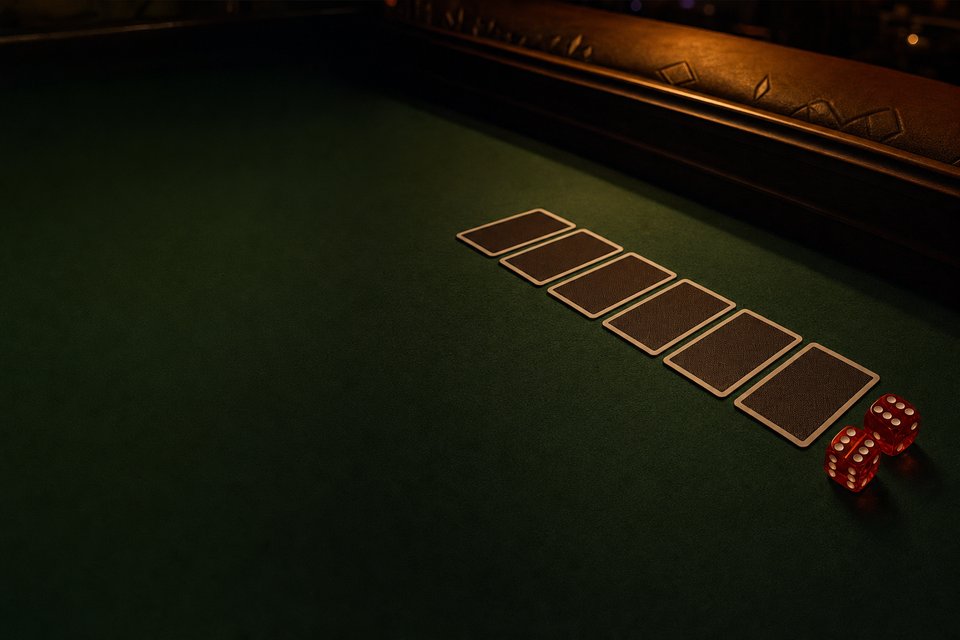
In the second family, real dice pick the cards. Pala uses regulation dice and six cards numbered one through six. Graton describes the same idea: six cards used in tandem with real dice, where the tops of the thrown dice dictate which cards count. Barona and Sycuan run similar games.
Why bring dice back at all?
Players like throwing them. A shooter holding real dice, a table cheering a point, the dice pushed back across the felt for the next throw: that is the atmosphere people come for. Letting the dice select the cards keeps all of it while leaving the legal outcome with the cards, which is what the state’s classification requires.
Do the odds change when cards replace dice?
Not when the deal is done properly. If each roll uses a full set of one to six for each die, shuffled fresh, every total arrives with the same 36 combinations as two dice. A 7 still comes six ways, a 6 or 8 five ways, and the craps odds you learned at a dice table hold card for card.
A game dealt from a big shoe differs slightly. The Wizard of Odds site describes a California card craps game dealt from a 264-card shoe holding 44 of each rank. Because drawn cards are not put back, each roll depends a little on what came out before. The shift per roll is small, but it is not zero.
For your betting decisions none of this matters much. The pass line still costs 1.41% of each bet, the don’t pass 1.36%, and odds behind either line cost nothing. The price list on the layout is identical, so the same simple game plan works at a California table as in Las Vegas.
Oklahoma craps: from cards to real dice
Oklahoma took a different road. Its tribal compacts for years did not cover dice games, which is why Oklahoma craps was built around cards or other devices. In April 2018 the governor signed House Bill 3375, which offered tribes a compact supplement for table games involving a wheel, ball or dice.
The catch is the definition. The games must be non-house-banked: the tribe has no interest in the outcome, all bets go into a common pool, and winnings are paid from that pool. The tribe pays the state ten percent of the monthly net win of the pools and may charge players a fee to take part, hence Oklahoma table antes.
Many Oklahoma rooms now deal craps with real dice. Official pages list live craps at the Choctaw resorts in Durant, Pocola and Grant, with up to 10x odds, and at Hard Rock Tulsa, Riverwind, WinStar and the Osage casinos. River Spirit in Tulsa and Grand Casino advertise no ante on craps, worth checking before you pick a table.
Where to play card craps in California
Official casino pages list card-based craps at Pechanga Resort Casino in Temecula, which calls it Pechanga Card Craps and advertises 5x odds, at Barona in Lakeside, Sycuan in El Cajon, Pala, Graton in Rohnert Park, Thunder Valley near Sacramento, Chukchansi Gold in Coarsegold and Cache Creek in Brooks. Our casino directory lists the addresses.
A few California rooms skip live tables and offer electronic craps instead. Blue Lake Casino Hotel and Morongo list bubble craps machines, and Chumash offers craps on stadium terminals. Those are covered on our bubble craps and electronic craps pages. Real-money online craps is not legal in California at all.
What to check before you sit down at a card craps table
Look at the odds limit first. Several California rooms advertise 5x odds, generous by national standards, and the odds are the one bet with no house edge. Then read the field. Barona says its field pays triple on the 12, and at that price the field bet costs 2.78% instead of the usual 5.56%.
Finally, ask how the cards are dealt. A fresh set of one to six for every roll plays exactly like dice, while a large shoe drifts slightly as it empties. Most players never notice. If you track results, though, it is the first question to put to the dealer before your first bet goes down.